Friday, September 13, 2013

Flint knapping and language--follow-up

The best comment I've seen on this study (see the previous post): "More proof that flintknapping is the origin of swearing" by Peter Mills (on the university press release website).

Thursday, September 12, 2013

Flint Knapping and the Evolution of Human Language

The idea that tool-making and the human capacity for language were linked has been floating around for a while, but a new article in PLoS ONE uses brain imaging to show they really are connected, through the activation of the same lateralized parts of the brain.

Citation:

Uomini, Natalie Thaïs and Georg Friedrich Meyer (2013) Shared Brain Lateralization Patterns in Language and Acheulean Stone Tool Production: A Functional Transcranial Doppler Ultrasound Study PLoS ONE 8(8): e72693. doi:10.1371/journal.pone.0072693.

They actually hooked flint knappers up to a functional transcranial Doppler Ultrasound machine while they made Acheulean handaxes and, alternately, produced words based on initial letter cues. The latter is evidently an established test for brain lateralization in linguistic production. The two tasks are reported to have produced very similar and highly correlated brain activity as measured by blood flow. If you're wondering why they didn't use one of the better known brain imaging techniques, such as functional MRI, think about the knapping. Most imaging techniques won't work properly if you're whacking away a big nodule of stone. They found some pretty handy knappers. The handaxes are pretty impressive (see Figure 2, but note that the captions of Figures 2 and 3 seem to have been swapped). Don't miss the video of one of the knappers.

The authors suggest that tool making by flint knapping may have played a role in the co-evolution of language, starting with the Acheuleans (Lower Paleolithic). This would be earlier than many of the chronological estimates for the emergence of language, which often rely upon analyses of anatomy and morphology. Overall, the PLoS ONE article is pretty interesting and clever research. I knew there had to be a reason I was studying those chips of stone.


Big Mound City

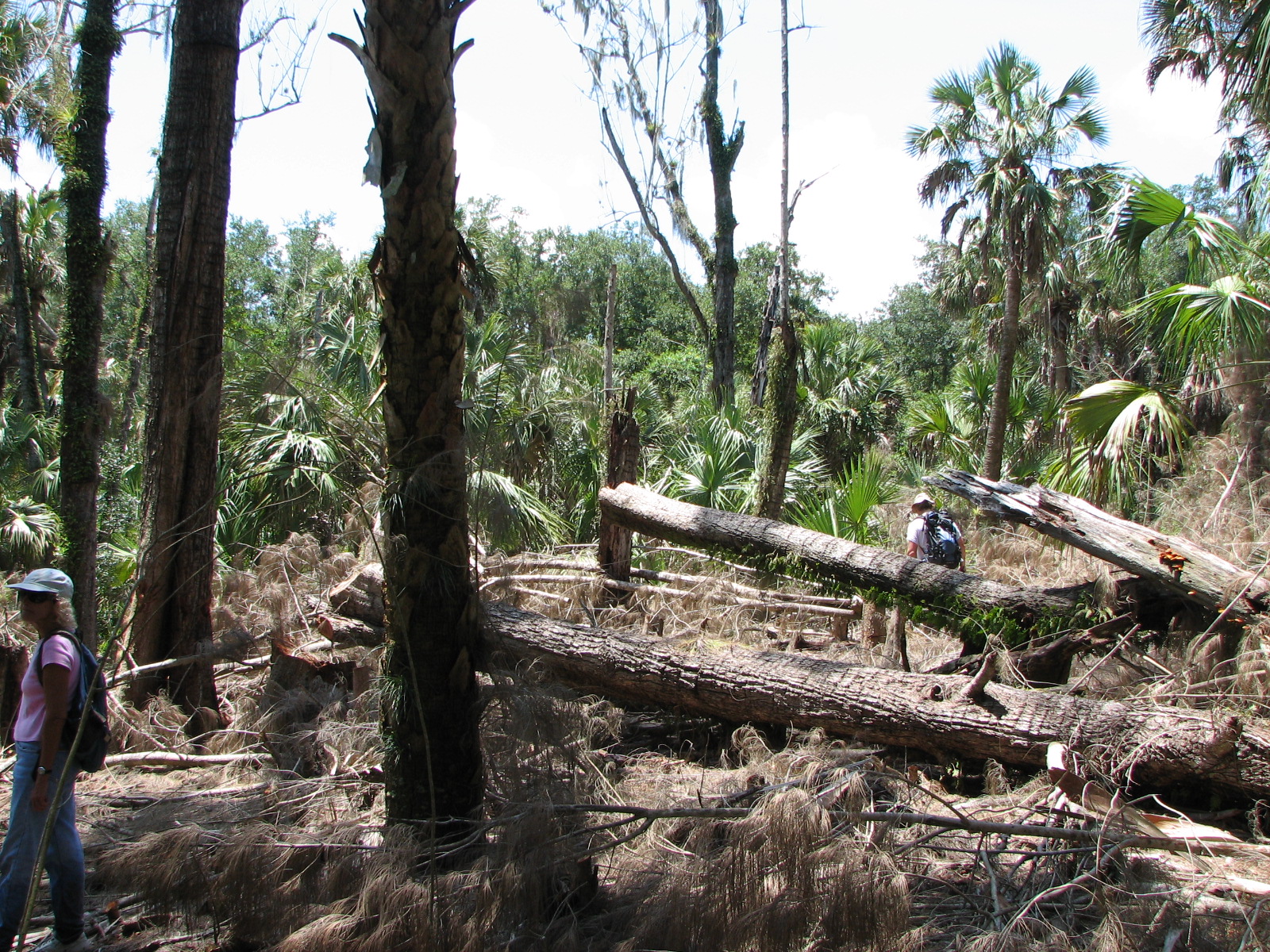
Big Mound City is one of the largest prehistoric mound sites in Florida, if not in the whole southeast. It's poorly known and quite inaccessible. There are two ways to get there. From the west, you can drive to within about 500 m of the site, but that last half kilometer is a doozy. It's a four-foot deep swamp full of alligators and water moccasins. From the east, it's over 20 km down a muddy road that can only be traversed in a giant mud buggy with 2 m high tires. The first time I went, in 2008, we came in from the west and it was mortally exhausting. The next time, we took the mud buggy. The isolation may have helped preserve the site (it's hard to get there, which limits the mischief), but it also leaves it vulnerable to those who do manage to get there, who seem to be mostly 3- and 4-wheel ATV enthusiasts and hunters. We saw little evidence of purposeful or effective looting, but plenty of destruction was visible. It has come from culling trees, off-roading, and, most significant, rooting and wallowing by herds of feral hogs. The latter is shockingly deleterious for archaeological deposits because it completely disturbs the top layer of soil, down perhaps 30 or 40 cm over large areas. Here are pictures from the first trip.

Ruins of a hut on one of the mounds

Recently (2008) felled large trees on the mounds

Feral hog rooting

More feral hog rooting

Yet more feral hog rooting
Here are pictures from the second trip, in 2011. This is in winter, in December. With the wind from the mud buggy, I was actually very cold. It's the only time I can remember being cold in Palm Beach County, Florida.

Mound in winter

Big mound covered with palmetto

Mound


The site deserves intensive archaeological investigation. It has great potential for tourism, but access would have to be created, though that would not be particularly difficult. Before the site could be opened for tourism, we would have to do some archaeology, if only to provide sensible interpretation. The site needs to be properly mapped and dated. It sure would be nice to know about the functions of the mounds and the causeways connecting them. There may also be a charnel pond there that ought to be located and properly protected and conserved.

The feral hogs need to be controlled. The site is located within a large state wildlife management facility. The hogs can be shot during the appropriate interval of hunting season. We probably need to do that. Don't ask me who "we" is.

(I started this blog post in April 2011. I just finished it after having noted a draft post languishing in cyber-oblivion.)


Update-Nicaragua

Apologies for the long hiatus....I should probably change the name of the blog to "Sorry for not posting recently," but perhaps it would be easier to stipulate that I'm always sorry for not posting more frequently. Okay?

My contrition for infrequent posting pales, however, compared to my remorse for the quality of the posts. I recently found myself reading Elif Batuman's moribund blog. (Digression alert--For the less hip, Elif is a brilliant young writer, author of The Possessed. She writes frequently for The New Yorker. I recently read an interesting article by her in The New Yorker entitled "Poisoned Land". It was about a mysterious kidney disease in the Balkans and the various theories that have been proposed to explain it. I found the piece interesting in part because of the relationships it illustrated among disease, hydrology, geology, and geomorphology. The article made me think about the multiplicity of possible causes for the even-more-mysterious kidney disease killing people along the Pacific Coast of Central America. --End digression) I just don't understand how someone--and she is not alone--can generate such quantities of graceful and interesting prose. It reminds of Michael Smith's lament for his clear but not vivid prose. I agree with him. Most of would be overjoyed just to achieve clarity.

Pausing the self-flagellation just momentarily, I can at least point to credible excuses for not posting lately. At the time of the last post, in March, I was racing to prepare and submit my permit request for this summer’s field work in Nicaragua.  Then I became trapped in the regular end-of-semester crush, while simultaneously ordering equipment, arranging travel, and preparing for the fieldwork.

This year I went into the field earlier —from mid-May to early July—than on previous occasions, when I went during the second half of our summer. Turns out that it rains more in the first half of the summer. Not enough to ruin the fieldwork, but we definitely lost more time to rain than we have in the past. I took with me two grad students, Kelin Flanagan and Ashley Hampton. They were great. The house we rented was mediocre: too small, with poor access and only intermittent running water. At one point, the little bridge leading to our street collapsed, and we had to drive several blocks around to get home. On several occasions, we had to bathe out of buckets for lack of running water.  Still, it was better than the Side Track Tap we rented last time.

Kelin and Ashley, very cool.


We found a number of sites but only worked at four of them, of which three were particularly interesting: Dulce Nombre de Jesus, Cosmapa Oriental, and La Trinidad. (Actually, we had discovered the first site a number of years ago, but we explored it more thoroughly this summer and found a bunch of cool stuff. [Sorry about that fancy archaeology jargon.]) Here is a map showing the locations of the sites we have found so far in the Department of Chinandega.

Map showing the location of archaeological sites we have identified to date (2013) in the Department of Chinandega.
If you want more information about the results of our fieldwork, feel free to consult the preliminary report of our fieldwork that I have posted on my website. Follow the link to "Nicaraguan Research" page where you will find a link to the MicroSoft Word document.

After returning from Nicaragua, I had, according to the terms of my permit, only 30 days to prepare this preliminary report. Actually, I had less than 30 days because it took several days for Fedex to ship the document to Managua. Given the short time available for it s preparation, I'm proud of the report. If you find any errors (there are of course omissions, like the lab results, which are still not finished), please let me know at my office e-mail address, ctbrown "at" fau.edu.

To continue with my excuses, writing the preliminary report sucked up the rest of my summer, which flashed by in a blur--I was working in the office early in the morning the day after I got back from the field. Then the new semester started, and I inexplicably agreed to chair a couple of committees. I should probably get a brain scan to see if I have a tumor pressing on the part of the brain responsible for generating the word "no." Maybe they'll name a new kind of aphasia after me.

Monday, March 25, 2013

WWXD

One of the great but secret pleasures in life is living with a library in the next room.

Late at night, when you finish one book and starting looking for the next, and you're not sure what you're in the mood for, you have a wonderful selection from which to choose. With a little luck, you can always find something to put you to sleep.

That is how, last night, I curled up with Miguel de Unamuno's Amor y Pedagogía, which I pulled off the shelf because I thought it was about amor y pedagogía. Not so much, as it turns out, but I found a jewel in it nonetheless. In the prologue he writes, "No sabemos que haya escritor a quien aborrezca más que a éste [Moratín], no siendo a Jenofonte. ¿Qué habrá hecho Jenofonte?

"Sí, ésta es la cuestión: ¿qué le habrá hecho Jenofonte?"

Although I'm not a classicist, I do love the idea of asking oneself, "What would Xenophon do?" Hence the title of the post.

I had found myself searching for a new book because I had unexpectedly finished the last surprising jewel I plucked off my shelves: Down the Great Unknown: John Wesley Powell's 1869 Journey of Discovery and Tragedy Through the Grand Canyon by Edward Dolnick. Good story, well researched, and supplemented by some thoughtful commentary that explorers might find interesting. I suppose that if you're an explorer, you could ask yourself, "What would Powell do?" but it doesn't have the same ring.

In between Dolnick and Unamuno, I studied a bit of matrix algebra, which was fun, but after a certain hour I find I cannot concentrate enough to fruitfully read math.

To be fair, I didn't spend the weekend in light reading or in contemplating the immortality of the crab. I spent 15 to 20 hours working this weekend, first on the permit request for this summer's fieldwork and then on a monograph I hope to send out soon. Probably not what Xenophon would have done.


Friday, February 22, 2013

The Golden Ratio in Ancient Maya Settlement Patterns

According to a very interesting article that just appeared in the Journal of Archaeological Science, the ancient Maya apparently used the Golden Ratio, phi, in their architectural layouts. Phi (φ) is the natural constant that arises when the ratio of two measurements is the same as the ratio of their sum to the larger of the two original measurements. It is an irrational number close to 1.618.... James Doyle, the author of the article, found that the plaza encompassed by a Late Preclassic E-Group at El Palmar, Guatemala, is a Golden Rectangle, that is, a rectangle in which the lengths of the sides exhibit the Golden Ratio.

Diagram of the Golden Ratio (from Wikipedia).


It should be noted that Margarita Martínez de Sobral previously suggested that the ancient Mesoamerican peoples employed the Golden Ratio in their art and architecture. She pointed to the proportions of Lintel 25 from Yaxchilan, but she offered few architectural examples of the principle. Martínez de Sobral also discussed several other interesting geometric constructions that may be observed in ancient Mesoamerican art and architecture.

I hope that Doyle's article inspires further research into this interesting aspect of ancient mathematics and aesthetics.

References

Doyle, James A. (2013). Early Maya geometric planning conventions at El Palmar, Guatemala. Journal of Archaeological Science 40:793-798. http://dx.doi.org/10.1016/j.jas.2012.08.006.

Martínez de Sobral, Margarita (2000) Geometría Mesoamericana. México: Fondo de Cultura Económica.


Wednesday, December 5, 2012

EVERYONE is blogging

One of my students (thanks, Travis!) sent me this link to the U.S. government's announcement, on its blog, that the world is not ending on December 21, 2012. Good to know the government is on the case, but for me the most fascinating thing is to discover that the United States government actually has a blog. With open commenting! Many of the posts look interesting, so I was surprised to see the unusually large number of comments on the 2012 post. The number currently stands at 148, while most of the other posts just have a few. I scrolled through several pages of blog posts, and the second highest number of comments I saw was 6. So, the level of 2012 hysteria really is high.

Friday, September 14, 2012

Pictures of the lesula, the new species of monkey, courtesy of Kate Detwiler

 Fabulous drawing of the lesula by Kimio Honda. You don't often see scientific illustration taken to such artistic heights.

 Georgette with her lesula. Photo by John Hart.

Adult lesula. Photo by Maurice Emetshu.

 Juvenile lesulas. Photo by John Hart.

 Captive lesula. Photo by John Hart.

Lesula with marantaceae. Photo by John Hart.

Thursday, September 13, 2012

New Species of Monkey Found in the Congo, by my Neighbor

Exciting discovery of a cute and charismatic new species of monkey, Cercopithecus lomamiensis sp. nov. This doesn't happen every day.

Here's a link to the article in PLoS ONE:

http://www.plosone.org/article/info:doi/10.1371/journal.pone.0044271

Kate Detwiler, the corresponding author, sits in the office next to mine. I helped her gear up for the trip to the Congo, but the courage it took was all her own. I don't know if I'd go.

If you're not sure whether you want to plow through the peer-reviewed article, here's a link to a National Geographic article about the discovery.


Wednesday, June 20, 2012

David Stuart's Review of "Cracking the Egyptian Code"

David Stuart has charmingly reviewed Andrew Robinson's Cracking the Egyptian Code: The Revolutionary Life of Jean-François Champollion in the Wall Street Journal. Evidently, when Champollion made his breakthrough, he cried out, "Je tiens mon affaire!" Google translates this as "I want my business," which seems like a strange thing for an epigrapher to yell.

Notwithstanding, sounds like a good book.